Showing posts with label What to Visit. Show all posts

Thursday, October 27, 2011

Suggested itinerary

Your itinerary will, of course, depend on the number of days you can take off work. For some of you who are visiting India for the first time, and have the time to go a-visiting, this will indeed be an awesome trip!

If you're only attending the wedding

Since the wedding is in Lucknow, which is equidistant by air from both Delhi and Kolkata, I would suggest, to make the most of your trip, try the following itinerary-
  1. Fly in to Kolkata
  2. Spend a day in Kolkata
  3. Fly to Lucknow for the wedding
  4. Experience the wedding hoopla!
  5. Go to Agra and see the Taj Mahal
  6. Fly to Delhi
  7. Spend a couple of days in Delhi or take this train package
  8. Fly back home!
If you have another two-three days, it would be a good idea to cover Jaipur, in Rajasthan to see some awesome palaces, do a Camel safari and experience the colors of the Rajasthani lifestyle! Agra to Jaipur is a short road trip. And this way you would be able to cover the golden triangle i.e. Agra-Jaipur-Delhi. You can read more here.

Of course, if you prefer visiting Nepal over Delhi, you can go there before the wedding.

If you're attending both Wedding and Reception

If you will be able to attend the Wedding Reception in Chennai, I would recommend the following itinerary
  1. Fly to Delhi
  2. Spend a couple of days in Delhi
  3. Fly to Lucknow for the wedding
  4. Experience the wedding hoopla!
  5. Go to Agra on Feb 6th afternoon & reach at night
  6. See the Taj Mahal/Agra Fort/Fatehpur Sikri on 7th
  7. Fly/drive/take a train to Delhi on 8th morning
  8. Fly to Chennai on 8th afternoon
  9. Attend the reception
  10. Return home!
If you have a couple of days more, you can visit Mahabalipuram near Chennai. It has an amazing array of temples with ancient architecture.

Lucknow

Lucknow, the capital of the state of Uttar Pradesh, is a city synonymous with Nawabi culture. The imperialistic splendor and magnificence of the Nawabi era has been glorified and eulogized down the ages by writers, poets, and historians alike.

Both the engagement and the wedding are scheduled to be held in Lucknow.If you arrive in Lucknow for the Mehendi, you can see the following places besides going crazy shopping.. :)

Rumi Darwaza

Rumi Darwaza, Lucknow
The Rumi Darwaza (Rumi gateway) is an imposing gateway which was built under the patronage of Nawab Asaf-Ud-dowlah in 1784. It is an example of Awadhi architecture.

Rumi Darwaza, stands sixty feet tall, was modeled (1784) after the Sublime Porte (Bab-iHümayun) in Istanbul. Over time it has become a logo for the city of Lucknow.


Bara Imambara

Bara Imambara, Lucknow
One of the major attractions of Lucknow, Bada Imambara was built in 1784 by Asaf-ud-Daula as a famine relief project. Actually a tomb of a Shiite Muslim holy man, Bada Imambara is known for its central hall. The central hall is a 50 m long and 15 m high arched room. It is one of the largest vaulted galleries in the world without any pillar.

Bhulbhulaiya is another attraction of Bada Imambara, which can be reached by an external stairway. In the tomb complex there is a mosque with two tall minarets, but non-Muslims are not allowed to enter inside.

Hussainabad Imambara

Chota Imambara, Lucknow
Also called the Chhota (Small) Imambara, Hussainabad Imambara was constructed in 1837 by Mohd Ali Shah as his own tomb. The Imambara has a large courtyard that encloses a raised rectangular tank with small Taj Mahal like imitations on each side. One of them is the tomb of Ali Shah's daughter and the other that of her husband. Main structure of the Imambara is topped by a golden dome and contains the tombs of Ali Shah and his mother. Just opposite of the Imambara is the decaying watch tower, known as Satkhanda or the Seven Storey Tower. West of the Imambara lies the Jama Mosque.

Residency

Residency, Lucknow
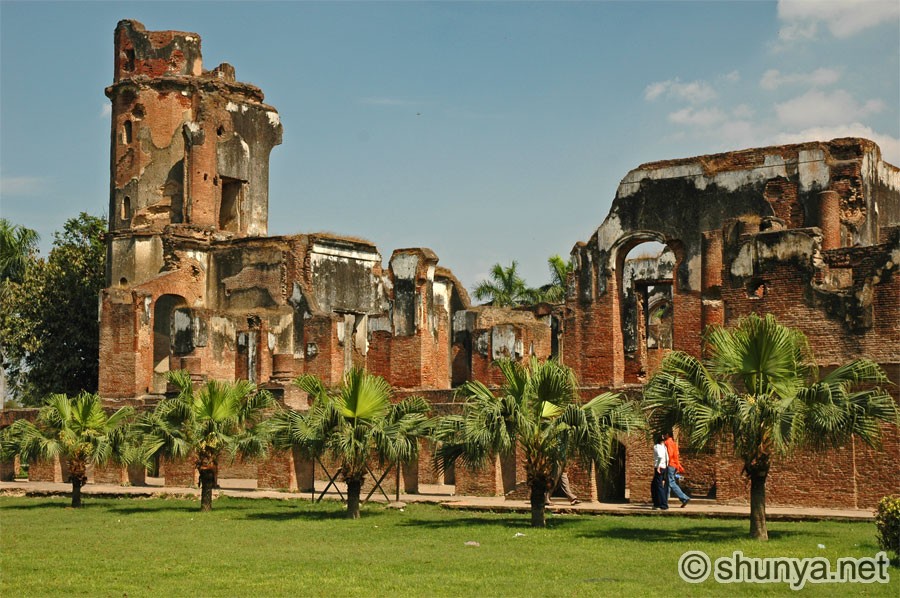
Constructed in 1800 by the British Resident, the Residency (a group of buildings) became the stage for the important events of the Uprising of 1857. Now mostly in ruin, the Residency is peaceful and surrounded by lawns and flowerbeds. Since India's Independence very little has changed in the structure of the Residency, only major work done here was the unveiling of an Indian Martyr's Memorial. The model room in the main Residency building is worth visiting, downstairs you can see the cellars where women and children lived throughout the siege.

Chennai

Chennai is the capital of Tamil Nadu and is located on the Coromondal coast of Bay of Bengal. It boasts of rich historical legacy which lends an inexplicable charm to the city. The Portuguese arrived here in the 16th century and were followed by the Dutch, and East India Company. The British were able to establish their undisputed supremacy in the city and the Fort St George became the nucleus around which the British authority grew and expanded.

The wedding reception is scheduled to be held in Chennai on Feb 8th 2012. If you are visiting Chennai you can take some time to see the following tourist attractions.

Fort St. George

Fort St. George
Built in the 17th century, this fort was built under the supervision of Francis Day and Andrew Cogon and houses St. Mary's Church and a museum. Built in 1680, St. Mary's Church is the oldest Anglican Church in India and has some of the oldest British tombstones in India. It was here that the marriage of the couple who founded the Yale University in the States was solemnized.

Fort Museum

The museum has on its display many relics belonging to the times of British Raj in India and exhibits a collection of contemporary paintings as well as the rare military paraphernalia such as weapons, uniforms, coins, costumes and medals.

Kapaleeswarar Temple

Kapaleeswarar Temple
The biggest temple in the city is a fine specimen of Dravidian architecture. The Shaiva temple has 13th century inscriptions and a 37-metre gopuram remarkable for its intricate carvings depicting stories from Hindu mythology.


Sri Parthasarathi Temple

Sri Parthasarathi Temple
The 8th century Krishna temple was built under the patronage of the Pallavas and enshrines idols of the five avataras of Sri Vishnu. The small temple inside is dedicated to Vishnu's consort, Vedavalli Ammai.


Santhome Cathedral

Santhome Cathedral
San Thome at the southern tip of Marina features the beautiful stained glass window at the basilica depicting the story of St Thomas and the central hall that has 14 wooden plaques depicting scenes from the last days of Christ. The 3-ft high statue of Virgin Mary was imported from Portugal in 1543.


The Marina Beach

Marina Beach
The 12-km long famous Marina Beach is the second longest beach in the world. It is best to visit the beach early in the mornings or late in the evenings when the area becomes a virtual fair ground with food stalls and other entertainments.


Valluvar Kottam

Valluvar Kottam
The memorial to the great poet-saint of Tamilian literature, Tiruvalluvar, is actually the replica of the temple chariot in Thiruvarur. A 33m tall statue of the saint has been installed in the chariot. His famous work Thirukkural has been inscribed on stone in the front hall corridors of the chariot. The memorial is said to have the largest auditorium in Asia with a capacity of 4000 people.

Agra (Taj Mahal)

Agra aka Akbarabad is a city on the banks of the river Yamuna in the northern state of Uttar Pradesh, India, 363 kilometres (226 mi) west of state capital, Lucknow and 200 kilometres (124 mi) south from national capital New Delhi. It achieved fame as the capital of the Mughal emperors from 1526 to 1658 and remains a major tourist destination because of its many splendid Mughal-era buildings, most notably the Tāj Mahal, Agra Fort and Fatehpūr Sikrī, all three of which are UNESCO World Heritage Sites.

The Taj Mahal

The Fabulous Taj Mahal, Agra, India
The Taj Mahal was built by a grief stricken Emperor Shahjahan as a memorial to his beloved wife Mumtaz Mahal. A world-renowned wonder, Taj Mahal sits pretty on the northern side of this green paradise. It looks the same from all the four sides! The Quranic inscriptions on its four entrances are carved in such subtle increase in size that may appear to be of the same size from top to bottom! Shahjahan invited master craftsmen from as far as Italy and Persia to help design his ambitious tribute to love.
The Taj Mahal is phenomenal not in the beauty alone that shines forth, but in the deep planning and design that went into its making, and the ethereal idea of immortalizing love. Delicate carvings in marble vie with gorgeous pietra dura for attention. Lapis-lazuli, Cornelian, Mother of pearl, Agate and Emerald are inlayed in floral and geometrical patterns in the marble itself. This enchanting mausoleum, on the bank of river Yamuna started in 1631 and it took 22 years to complete with the help of an estimated 20000 workers.

The Agra Fort

Agra Fort, Agra
The great Mughal Emperor Akbar commissioned the construction of the Agra Fort in 1666, A.D. although additions were made till the time of his grandson Shahjahan.

The forbidding exteriors of this fort hide an inner paradise. There are a number of exquisite buildings like Moti Masjid - a white marble mosque akin to a perfect pearl; Diwan-I-Am, Diwan-I-Khaas, Musamman Burj - where Shahjahan died in 1666 A.D. Jahangir's Palace; Khaas Mahal and Shish Mahal.

Fatehpur Sikri

Buland Darwaza, Fatehpur Sikri
Built during the second half of the 16th century by the Emperor Akbar, Fatehpur Sikri (the City of Victory) was the capital of the Mughal Empire for only about 10 years. The complex of monuments and temples, all in a uniform architectural style, includes one of the largest mosques in India, the Jama Masjid.
There are multiple well preserved monuments in the city.

Diwan-i-Am, the Hall of Public Audience, is encircled by a series of porticos which are broken up by the insertion of the imperial box where Akbar, surrounded by his ministers and officers meted out justice. This box communicates directly with Daulat Khana (Imperial Palace), flanked to the north by Diwan-i-Kas (Hall of Private Audience), called the 'Jewel House', a monument known for its central plan, which comprises an extraordinary capital surmounted by a circular balcony: the 'throne'.

Other monuments of exceptional quality are the Panch Mahal, whose elevation of four recessed storeys recalls certain Buddhist temples, the pavilion of Anup Talao, or the Turkish Sultana, the palace of Jodh Bai, the palace of Birbal, the caravanserai and the problematic 'stables'.

Sikandra

Entrance to Sikandra
Sikandra is the mausoleum of Mughal Emperor, Akbar the Great (1542–1605), Akbar himself commenced its construction in around 1600, according to Tartary tradition to commence the construction of one's tomb during one's lifetime. Akbar planned his own tomb and selected a suitable site for it. After his death, Akbar's son Jahangir completed the construction in 1605-1613.

Sikandra represents Akbar's philosophy and secular outlook, combining the best of Hindu and Muslim architectures in a superlative fusion.


Lucknow to Agra

Photo courtesy MapsOfIndia.com
The best way to reach Agra from Lucknow is by train. It is a 6-7 hour train journey. I'd recommend you take a morning train about 10 am from Lucknow on the 6th Feb. This would ensure you see the wedding ceremony as well as get to Agra by 5.30 p.m. and finish seeing the Agra Fort on 6th itself.

You will also be able to get some sleep on the train. Most trains have sleeper classes where you can sleep throughout the journey. I suggest traveling on the following train-


If you are making your own travel plans, booking a train is easy through http:/irctc.co.in. Look for e-tickets for trains.

Alternatively, you can take a tour package from one of the travel agents that I recommend.

Mahabalipuram

Shore Temple

Shore Temple, Mahabalipuram
The oldest structure in the area, built in 700 AD, this temple has been here for more than 1400 years. However, unlike Mamallapuram's other monuments, the Shore Temple is a building (not carved from rock) and the bulk of the current structure is a reconstruction after it was struck by a cyclone. It's not particularly large, and the carvings have been badly eroded by the wind and the sea, but this adds to the sense of antiquity. The area around the temple is now a landscaped park, with guards keeping the hordes of souvenir hawkers at bay. A Shiva lingam is enshrined in the central building and the site can get very crowded on weekends.

Five Rathas (Pancha Pandava Rathas)

Panch Ratha, Mahabalipuram
This site contains five rathas, literally chariots, dating from the 7th century. The sculptures are complemented by some enormous stone animals, including a large elephant.


The following structures are all carved straight out of rock in the central hillside area, so you can travel between them on foot. The scenery within the hills is also quite unusual, with smooth rock rising out of the forest and carved stairways leading between the mandapas (pavilions), caves and carvings.

Arjuna's Penance

Arjuna's Penance, Mahabalipuram
Also known as the Descent of the Ganges. A giant bas-relief filled with detailed carvings, including a family of elephants and monkeys. Archaeologists still squabble over what, exactly, the bas relief depicts; the central figure may actually depict Bhagiratha, not Arjuna.


Krishna's Butterball

Krishna's Butterball, Mahabalipuram
This is a giant natural rock perched on a hillside, seemingly in defiance of all laws of physics—it's a common sight to see visitors placing hands under the stone posing for pics, which looks as though they are holding it! The rock provides welcome shade if you dare to sit underneath it, and local kids have discovered that the slippery nearby hillside also makes a great natural slide.


Mahishamardini Cave

The central carving is of Shiva and Parvati and Murugan

Varaha Cave

This cave has four impressive carvings of Vishnu, Gakalakshmi, Trivikama and Durga.

Delhi

If you're flying to Lucknow via Delhi, you might wish to take a couple of days and explore the multitude of things you can do in the capital city.

Humayun's Tomb

Built by the wife of Humayun, Haji Begum in the mid 16th century, this red sand stone structure is considered to be the predecessor of Taj Mahal. The structure is one of the best examples of Mughal Architecture.


Old fort

It is believed that the Pandavas built their capital, Indraprastha at the place where the old fort stands today. This fort, now in ruins, was the seat of administration for many emperors. The legendary Prithviraj Chauhan ruled from here till he was defeated by Abdali in the battle of Panipat.


Red Fort

Built in Red Sand stone this imposing fort is 3 kms in perimeter with the height of the wall varying from 18 to 30 meters at places. The Lahore gate, the main entrance, has historical importance attached with the Indian independence. On 15th August (Indian Independance Day) the Indian Prime minister addresses the nation from here.

The Dewan-i-Am or the place of public hearing had a wall paneled with marble in laid with precious stone which were removed during the mutiny of 1857. The Dewan-i-Khas or the place for special hearing was the area where the emperor used to hold meetings with his ministers.

Jantar Mantar

Few minutes walk from Connaught Place is is a strange collection of salmon colour structures. These were built by Maharaja Jai Singh and is actually an observatory. Though not as large as its compatriot in Jaipur, Jantar Mantar at Delhi is also an attraction for tourists. These observatories can calculate many astronomical movements with amazing accuracy.
Qutab Minar

In 1199, Qutbuddin raised the Qutab Minar either as a victory tower or as a minaret to the adjacent mosque. From a base of 14.32 mtrs. it tapers to 2.75 mtrs. at a height of 72.5 mtrs. It is still the highest stone tower in India, one of the finest Islamic structures ever raised and Delhi's recognised landmark.


Rajpath & India Gate

Flanked by ornamental ponds and lawns, Rajpath is host to the Republic Day Parade. The two secretariat buildings and Rashtrapati Bhawan on the Raisina hills are located on the two sides of this immensely broad road.

India Gate is a 42m high stone arch of triumph. It bears the name of the 85,000 Indian Army Soldiers who died in the campaigns of WW1, the North-West Frontiers operations and the 1919 Afghan Fiasco. Below the arch is the memorial to the unknown soldier. India Gate is surrounded by green grass lawns and trees.

The Parliament House

Sansad Bhawan or the Parliament house is the supreme law making body in the country. It is the center of power and politicians decide the fate of the Indian Democracy here. Visitors are not allowed inside the house but when the house is in session, visitors may seek permission to watch the proceedings of the house. For foreign visitors', permits are given only after they obtain an introductory letter from their respective embassy.

Cities of Buddhist interest

There are multiple locations of Buddhist interest in the state of Uttar Pradesh. So if you're interested, you could take the route mentioned below-


Sravasti

Sravasti, capital of the ancient Kosala kingdom is sacred to Buddhists because it is here that Lord Buddha performed the greatest of his miracles to confound the Tirthika heretics. These miracles include that of the Buddha creating multiple images of himself, hence forth has been among the favorite themes of Buddhist art.

Kapilvastu

Today's Piprahwa 22 km from Siddharthnagar is identified with ancient Kapilvastu where Lord Buddha spent the early years of his life. Kapilvastu was the capital of the Shakya clan whose ruler was the father of Lord Buddha, and therefore Lord Buddha is also called as Shakyamuni. The Sakya domain was one of the sixteen independent principalities of the 6th century BC.

Prince Gautam, as the Buddha was then known, left his palace in Kapilvastu at the age of 29, and revisited in 12 years later, after attaining enlightenment.

Today, Kapilvastu Comprises of Several villages, mainly piprahwa and Ganvaria. A large Stupa stands at the ancient site which is said to have housed the bone relics of Lord Buddha. The presence of these relics is testified by an ancient Brahmi inscription found at Piprahwa. The ruins of the royal palace are spread over a large area.

Kushinagar

53 Km from Gorakhpur, Kushinagar, one of the principal centres of the Budhist piligrimage, is the place where Lord Buddha left his corporeal self and attained Mahaparinirvana.

Kushinagar was previously known as Kushinagar, which was the capital of Malla dynasty. It was one of the famous sixteen Maharanapads of ancient India. The Chinese travelers Fa Hien and Hieun Tsang have also mentioned kushinagar in their travelogues.

The credit for bringing this ancient site to light goes to General A. Cunningham and A.C.L. Carlleyle who, after excavating the site in 1861, established its antiquity for the first time. Later, between 1904 and 1912, several excavations conducted by the Archaeological Survey of India at Kushinagar confirmed its identity.
The monuments of Kushinagar are clustered in three distinct groups comprising the main site at the Nirvana Temple, the central Stupa and surrounding monasteries, the Mathakuar Kot to the south-west and the Ramabhar Stupa, a kilometer to the east.

Sarnath

After the Buddha attained enlightenment in Bodh Gaya he came to Sarnath. Here in the Deer Park, he delivered his first sermon, or in religious language, set in motion the Wheel of Law (Maha-Dharmachakra Pravartan.). On the day before his death Buddha included Sarnath along with Lumbini, Bodh Gaya and Kushinagar as the four places he thought to be sacred to his followers.